
RDEL #147: How does GenAI change when and how teammates talk to each other?
Routine questions move to AI (71% consult it on how to implement an algorithm) while human conversations shift toward context, clarification, and judgment.
Welcome back to Research-Driven Engineering Leadership. Each week, we pose an interesting topic in engineering leadership and apply the latest research in the field to drive to an answer.
On many teams, the steady stream of “quick question” pings has started to thin out, and teammates increasingly work a problem with an AI assistant before bringing it to their colleagues. Most discussion of AI coding tools centers on how they change an individual’s output, but they are also quietly rewiring how people on a team turn to one another. This week we ask: how does GenAI change when and how members of a software development team interact?
The context
For decades, the reason colleagues interrupt each other during development has been knowledge. When you can’t find an answer alone, a teammate is the fastest path, especially for the messy questions that require synthesizing context. But that path has a cost: every interruption breaks someone’s flow, and the interrupted colleague then has to rebuild their own mental context when they get back to their work. Teams have always lived with that tradeoff because the alternative was being stuck.
GenAI changes the math. A tool that can explain an API, debug an error, or suggest how to structure code on demand offers a new place to take the questions that used to go to a person. The interesting question for engineering leaders isn’t whether developers use these tools (they do) but what happens to the human side of the team when a big slice of everyday Q&A no longer needs a human. Does collaboration shrink, or does it change shape? Prior studies have come back with contradictory answers, which is exactly why this one set out to look more closely.
The research
Researchers ran a two-phase, mixed-method study to understand how GenAI changes the way developers interact with their teammates. Phase one followed 30 professional developers as they worked for 5 to 12 days, collecting 834 in-the-moment and end-of-day responses plus interviews with 22 of them. Phase two surveyed 131 additional developers to test whether the patterns held more broadly.
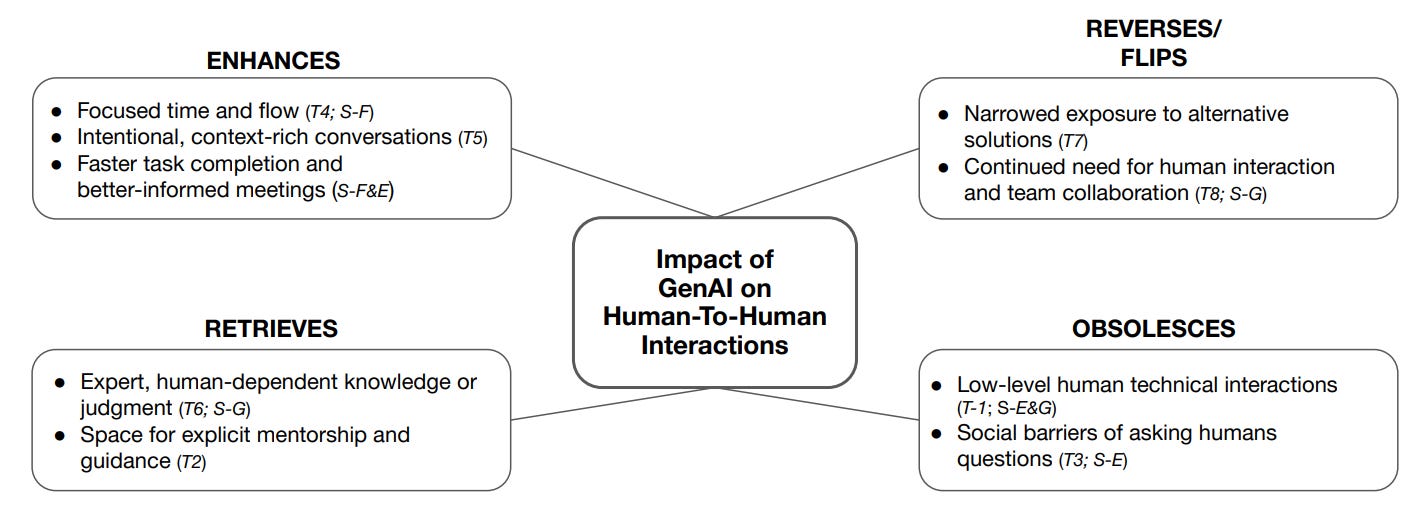
Here were their findings:
GenAI became a judgment-free technical mentor, and developers started taking routine questions to it instead of to teammates. Of the 131 surveyed developers, 51% said they now ask GenAI for technical help they once would have asked a person, and 62% said it was easier to ask GenAI without fear of embarrassment.
The promised gains in focus and flow are real but uneven. In-the-moment data showed fewer interruptions and smoother flow, but the broader survey was mixed: only 28% agreed interruptions had dropped, while 32% disagreed and 40% were neutral. The differentiator was integration depth, as developers on teams where GenAI was fully embedded in the workflow were significantly more likely to report fewer interruptions (p = .03). Meanwhile 59% reported faster task completion.
Conversations didn’t disappear, they changed purpose. A clear division of labor emerged:
Developers turned to GenAI for technical and planning work (71% for how to implement an algorithm, 60% for breaking down a task, 59% for brainstorming options)
Developers turned to colleagues for context (65% to clarify business logic or requirements, 50% for how something had been done before). The human conversations that remained shifted toward clarification, joint reasoning, and weighing alternatives.
Developers still actively wanted human interaction, for reasons AI can’t cover. Respondents claimed that GenAI tends to hand back a single consolidated answer rather than the multiple perspectives a colleague surfaces, and they kept seeking teammates for context-specific expertise, mentorship, and plain social connection.
The application
GenAI is redrawing the line between what you ask a tool and what you ask a person: routine Q&A is migrating to AI, and the human conversation that’s left is concentrating on judgment, context, and connection. That’s not necessarily an unhealthy shift, but does mean that organizations need to dedicate time and space for team interactions, especially in remote or asynchronous context.
Here’s how leaders can apply these findings:
Make delegation norms explicit. Don’t leave developers guessing where the line is. A simple team norm (”check GenAI first for framework-level how-tos, then bring me the part that needs context”) both reclaims senior time and removes the ambiguity engineers feel about when it’s okay to interrupt. This especially applies to newer or less experienced engineers.
Schedule mentorship and second opinions on purpose. When routine questions stop flowing to senior engineers, the casual teaching moments they created vanish too. Book dedicated mentorship time, and structure complex decisions so they require a second human viewpoint, directly countering GenAI’s tendency toward a single answer.
Rebuild the hallway deliberately. In hybrid teams especially, the troubleshooting pings that doubled as social glue are now going to a tool. Introduce lightweight, informal touch points so knowledge gaps surface early and connection doesn’t quietly erode.
The tools are good at handling the routine questions. The conversations that build judgment and connection are yours to protect.
Happy Research Tuesday!
Lizzie